
Historic Elegance. Modern Luxury.
Preserve the Past. Elevate the Present.
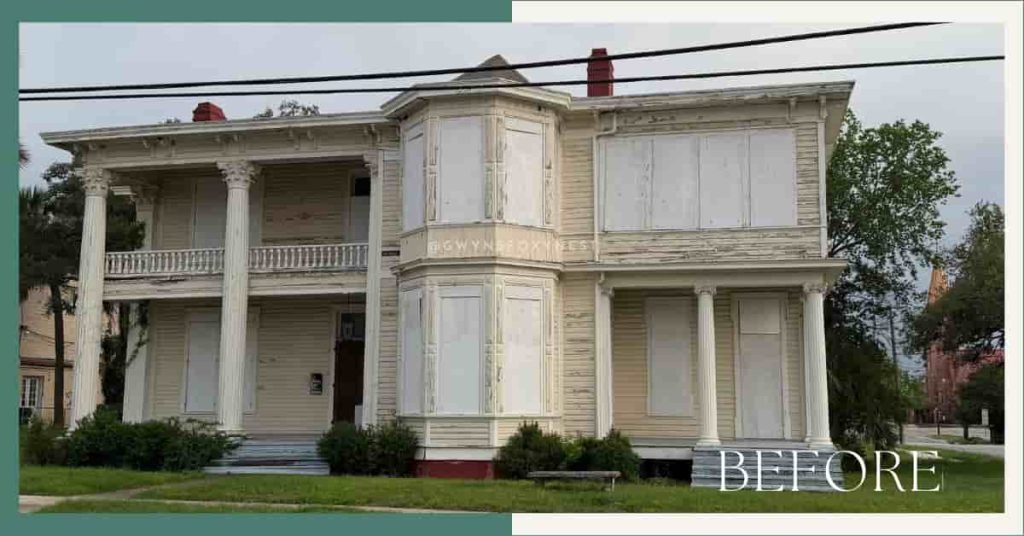
There are moments when you’re driving through a small Texas town, and something stops you cold. Not a restaurant or a shop but a house… A home… A two-story, boarded-up, peeling-paint beauty of a house that whispers through its weather-worn walls:
“I used to be extraordinary.”
That’s exactly what happened when I came across this remarkable property. And instead of driving on, I asked myself a question I couldn’t shake:
“What could this place look like?”
More Than a Colonial – A Texas Victorian Treasure
At first glance, you might call it a Colonial. But spend a little time with this home’s architecture and a much richer story emerges. This is almost certainly a
Victorian / Classical Revival Transitional home.
A style deeply rooted in the late 19th-century building boom that swept through Southern Texas during the railroad era. True Colonial homes are marked by perfect symmetry, centered front doors, evenly spaced windows, and simpler, more restrained rooflines. This house tells a completely different story.
Look closely, and you’ll see an asymmetrical massing, a projecting bay tower, ornate corbels and brackets, tall decorative columns, layered double porches, and Victorian-era trim details that speak to a very specific moment in American architectural history. One of ambition, craftsmanship, and regional pride.
Dating the Architecture: Why the 1890s Make Sense
Based on its architectural features, this home was most likely built between 1890 and 1910, with the strongest possibility pointing to the 1890s. Here’s what the building itself tells us:
The Tall Corinthian Columns
Those grand columns weren’t just decorative… They were a statement. This Classical Revival styling flourished between the 1890s and 1915, particularly in Southern towns that were rebuilding wealth and identity after the railroad boom transformed regional economies. To have columns like these was to announce:
“We have arrived.”
The Bay Window Tower
That angled projecting bay is unmistakably Victorian / Queen Anne-adjacent and firmly rooted in the late 19th century. At the time, a bay window tower like this was a luxury feature, a sign that the original owners spared no expense. It also adds the dramatic asymmetry that gives Victorian homes their unmistakable personality.
The Decorative Brackets and Corbels
Those ornate roofline brackets are a hallmark of Italianate architecture. A style popular in American homes from the 1870s through the 1890s. Texas towns, particularly those off the main coastal trade routes, often held onto these stylistic influences longer than northern cities. A Texas home built around 1895–1905 could absolutely carry Italianate details alongside newer Classical Revival elements. Styles overlap here. They tell a layered story.
The Double Porch
Perhaps the most regionally important detail of all: that wide, shaded double porch. Before air conditioning changed everything, this was engineering! A passive cooling system is built right into the architecture. Common in Gulf Coast towns and historic Texas downtown districts, this feature is both historically valuable and deeply human. It was designed so that families could live comfortably in the Southern heat, and it gives this home an extraordinary sense of welcome that no modern house can replicate.
The Vision: What AI Helped Me See
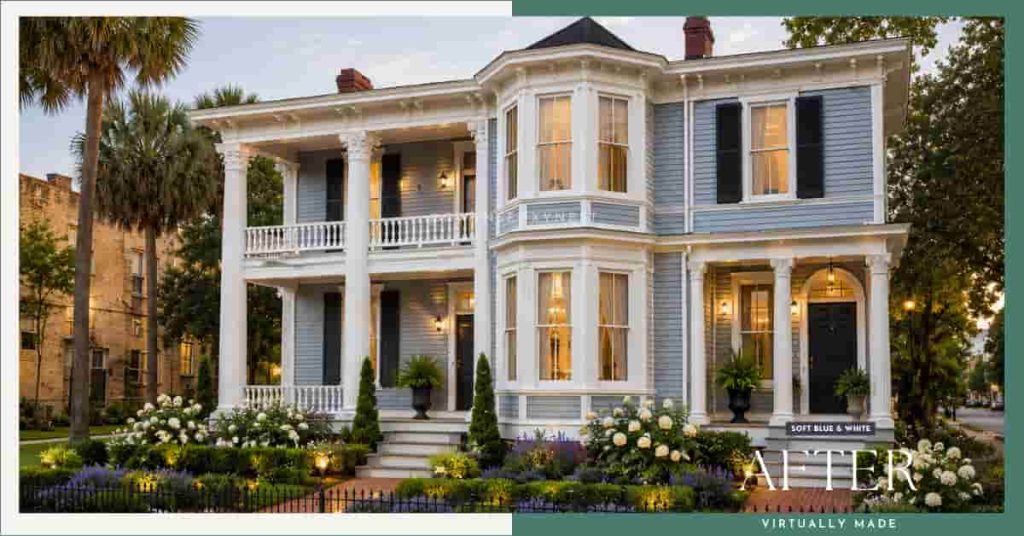
I turned to AI visualization not to reimagine this home as something it’s not, but to strip away the decades of neglect and let the home’s real personality come through. The goal was always to honor the history while revealing the potential.
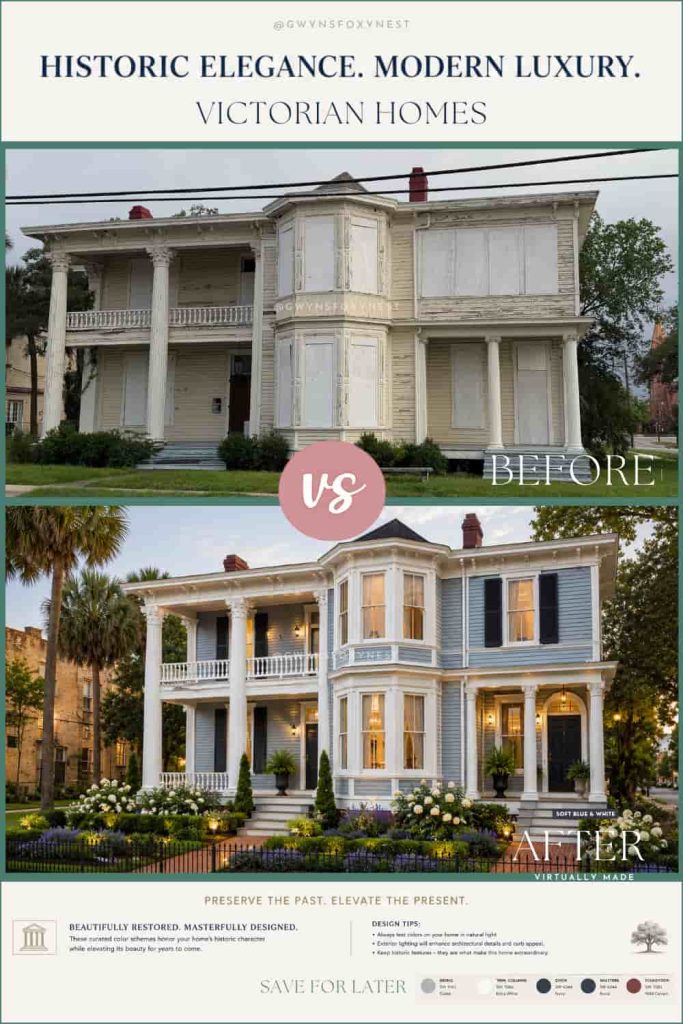
The result? A soft blue and white exterior with crisp window accents, a lush layered flower garden, warm architectural lighting glowing through the restored windows, a timeless, traditional brick pathway leading to the front doors, and a classic black iron fence framing it all.
Still historic. Still dignified. Just… breathtaking again.
Sherwin Williams Paint Colors Palette For A Modern Victorian House: Fresh, Timeless, and Historically Grounded
The paint colors chosen for this AI visualization weren’t selected at random. Muted blue-grays were historically used on Victorian homes, especially in Southern climates where the colors evoked coastal elegance and cooled the eye against the heat. This palette honors that legacy while feeling beautifully fresh today.
- Siding: SW 9143 Cadet — A sophisticated slate blue that reads as timeless and coastal, grounded in the Victorian palette while feeling elevated and modern.
- Trim & Columns: SW 7006 Extra White — Crisp, clean contrast that makes every architectural detail pop. Those gorgeous corbels and column capitals deserve to be seen.
- Doors & Shutters: SW 6244 Naval — A deep, commanding navy that anchors the home with drama and elegance. Period-appropriate and absolutely stunning against the blue siding.
- Foundation: SW 7583 Wild Currant — A warm, earthy red-brick tone that grounds the home and adds unexpected richness. A nod to the home’s deep Texas roots.
Design tip: Always test paint colors on your home in natural light (morning and afternoon) before committing. What looks perfect on a chip can shift beautifully or in surprising ways on a full exterior.
Here is a home actually painted in SW 9143 Cadet in real life.
The Potential Is Extraordinary Modern Vintage House Exterior
This home has what no new construction can manufacture: authentic historic proportions, impressive street presence, genuine architectural character, and rare surviving details that tell the story of a Texas town at the height of its ambition. With a thoughtful restoration…
… historically appropriate paint, period-correct shutters, warm exterior lighting, lush landscaping, brick or oyster-shell pathways, and black iron fencing …
… this becomes the kind of property people stop their cars to photograph.
The biggest visual wins in a restoration like this would be:
- Landscaping that layers color and texture from the fence to the foundation
- Warm architectural lighting that highlights the columns and bay tower at night
- Restoring trim detail contrast so the corbels and brackets read clearly
- Replacing boarded windows with period-appropriate glass
- Period-correct shutters in Naval blue
- Brick or oyster-shell pathways from the gate to the door
- Black iron fencing that frames the property with elegance
Done right, this home has a historic boutique inn, wedding venue, and featured magazine home written all over it. The bones are extraordinary. The story is already there. All it needs is someone willing to see past the boarded windows.
Now I want to hear from you.
If this were your home to restore, what would you do first? Would you keep the soft blue palette, or take it in a completely different direction? A wraparound porch extension? Window boxes overflowing with blooms? A bold front door color? Drop your vision in the comments! I genuinely want to see what you see in this place. Because sometimes, all it takes is a little imagination to turn a house back into the dream home it was always meant to be.
✦ @gwynsfoxynest ✦
Beautifully Restored. Masterfully Designed.